Thermal Break Aluminium Windows: Engineering Specification, Global Procurement Trends & Architectural Systems Guide
An authoritative technical analysis for international developers, facade consultants, and main contractors. Discover how advanced Polyamide (PA66 GF25) thermal barrier technology, custom alloy formulation, and Turkish manufacturing cluster dynamics optimize thermal efficiency ($U_w \le 0.8\text{ W/m}^2\text{K}$), structural wind-load integrity, and whole-life building carbon economics.
EN AW-6063 T6Primary Structural Alloy Standard
PA66 GF2524mm–34mm Polyamide Barrier
$U_w \ge 0.79\text{ W/m}^2\text{K}$Passive House Capable Ratings
Class 4 / E1050Air & Water Tightness Ratings
Technical Physics & System Fundamentals
The Engineering Science Behind High-Performance Thermal Break Aluminium Windows
Aluminium is prized in modern architecture for its exceptional strength-to-weight ratio, structural rigidity, and resistance to atmospheric corrosion. However, uninsulated primary aluminium possesses a high thermal conductivity ($\lambda \approx 160\text{ to }200\text{ W/m}\cdot\text{K}$). Without precise thermal isolation, standard profile sections act as severe thermal bridges, resulting in rapid heat loss in heating-dominated climates, intense solar thermal gain in tropical zones, and destructive interior condensation along window frames.
Thermal break aluminium windows solve this physical limitation by mechanically joining inner and outer extruded aluminium profiles using a low-conductivity structural polymer—specifically Polyamide 66 reinforced with 25% glass fibre (PA66 GF25). Polyamide features a thermal conductivity of just $\lambda \approx 0.3\text{ W/m}\cdot\text{K}$, effectively creating an impermeable thermal barrier that isolates exterior climate conditions from the interior envelope.
Class E1050EN 12208 water tightness under pressure
Evaluating Frame Thermal Transmittances ($U_f$) vs. Overall Window Metrics ($U_w$)
In international project procurement, misinterpreting thermal ratings often leads to compliance failures during building commissioning. The overall thermal transmittance of a window assembly ($U_w$) is calculated according to EN ISO 10077-1 / 10077-2 standard equations:
Where $A_g$ and $A_f$ represent the surface areas of the glass and frame respectively, $U_g$ is the thermal transmittance of the insulating glass unit (IGU), $U_f$ is the thermal transmittance of the thermal break aluminium frame, $l_g$ is the perimeter of the glass sightline, and $\Psi_g$ (Psi value) is the linear thermal transmittance caused by thermal interaction between the glass edge, warm-edge spacer bar, and frame cavity.
Afes Aluminium utilizes multi-cavity polyamide thermal break strips integrated with low-emissivity (Low-E) insulated foam inserts (PE/XPE insulation blocks) inside the frame chambers. By controlling convection currents within profile internal pockets, our engineered systems lower frame thermal values ($U_f$) down to $1.1\text{ W/m}^2\text{K}$, enabling total window assemblies ($U_w$) to comfortably meet demanding BREEAM Outstanding, LEED Platinum, and Passive House standards across all global climate zones.
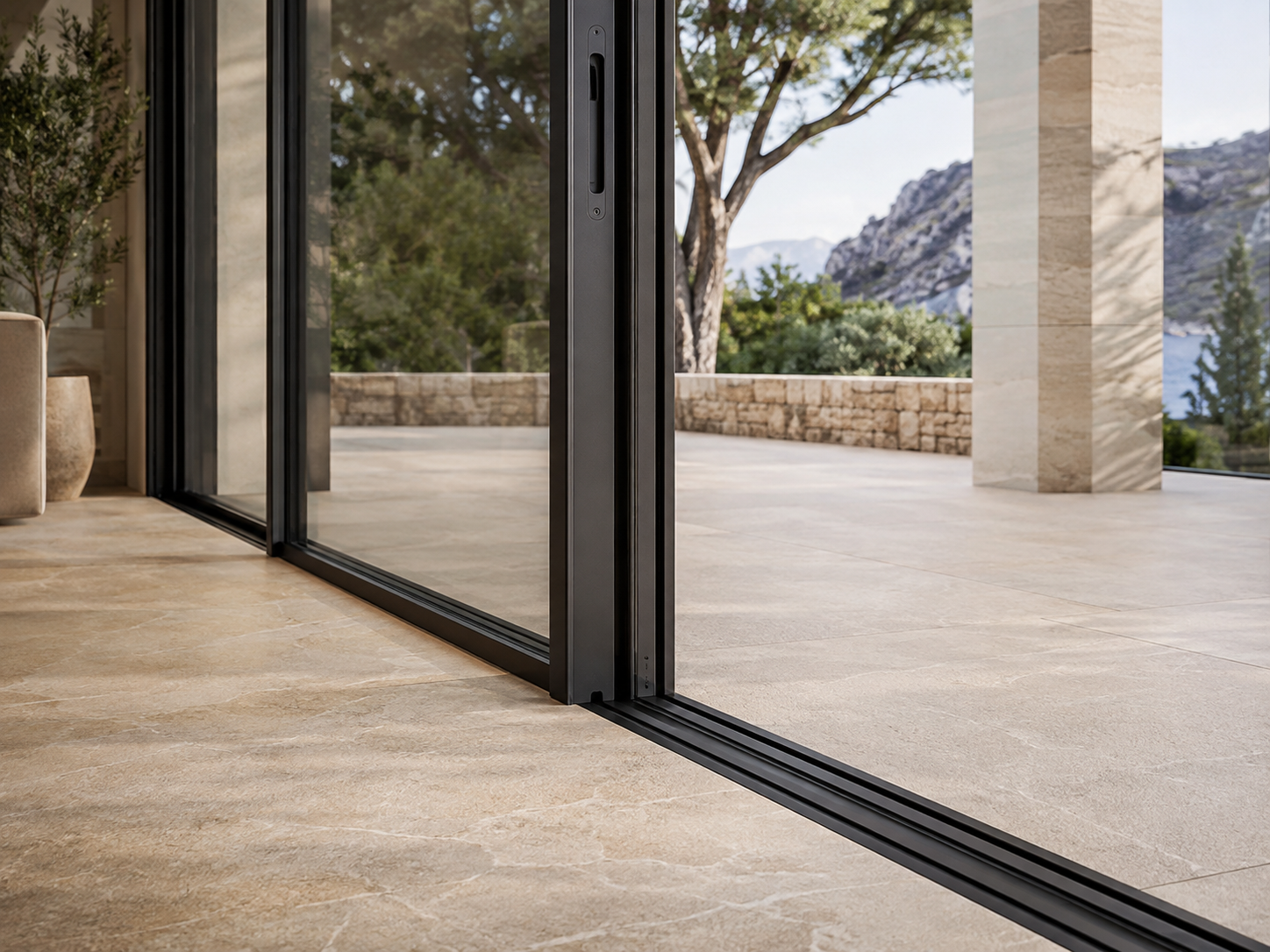
Heavy-duty thermal break sliding window system featuring ultra-slim interlock profiles ($32\text{mm}$) capable of handling heavy glass weights up to $400\text{kg}$ per sash.
Comprehensive Engineering Matrix: Afes Thermal Break Window Series
Below is an international engineering comparison of our standardized thermal break aluminium window profiles manufactured to EN 14351-1 harmonized standards:
Technical Feature
Iso-Slim 65 Series
Iso-Max 75 Series
Iso-Shield 90 Passive
Iso-Glide 150 Sliding
System Frame Depth
65 mm
75 mm
90 mm
150 mm (2-Track)
Polyamide Strip Width
24 mm (PA66 GF25)
34 mm Multi-Cavity
42 mm Insulated core
28 mm Dual Strips
Frame U-value ($U_f$)
$1.6 - 1.8\text{ W/m}^2\text{K}$
$1.1 - 1.3\text{ W/m}^2\text{K}$
$0.78 - 0.9\text{ W/m}^2\text{K}$
$1.5 - 1.9\text{ W/m}^2\text{K}$
Overall Window ($U_w$)
$\approx 1.2\text{ W/m}^2\text{K}$
$\approx 0.85\text{ W/m}^2\text{K}$
$\approx 0.72\text{ W/m}^2\text{K}$
$\approx 1.15\text{ W/m}^2\text{K}$
Air Permeability
Class 4 (600 Pa)
Class 4 (600 Pa)
Class 4 (600 Pa)
Class 4 (600 Pa)
Water Tightness
Class E900 (900 Pa)
Class E1050 (1050 Pa)
Class E1200 (1200 Pa)
Class 9A (600 Pa)
Wind Load Resistance
Class C4 (1600 Pa)
Class C5 (2000 Pa)
Class C5 (2400 Pa)
Class C3 (1200 Pa)
Acoustic Rating ($R_w$)
$38 - 43\text{ dB}$
$42 - 47\text{ dB}$
$45 - 50\text{ dB}$
$36 - 42\text{ dB}$
Surface Coating Standards
Qualicoat Class 2 Architectural Powder Coating / Qualanod Anodizing ($15\text{--}25\mu\text{m}$)
Market Intelligence & B2B Procurement
Future Procurement Trends in Thermal Break Aluminium Windows (2026–2035)
The global facade and fenestration industry is undergoing a structural transition driven by stringent energy efficiency legislation, decarbonization policies, and AI-optimized digital procurement workflows. B2B buyers—including main contractors, real estate developers, and building envelope importers—must align their supply chains with four decisive macro trends shaping the market:
TREND 01
CBAM & Low-Carbon Recycled Aluminium
With the European Union's Carbon Border Adjustment Mechanism (CBAM) entering full implementation, developers are penalization-proofing their orders by specifying secondary recycled aluminium billet ($\ge 75\%$ recycled content) or hydro-powered primary aluminium. This reduces embodied carbon from $18\text{ kg CO}_2/\text{kg Al}$ down to $< 4.0\text{ kg CO}_2/\text{kg Al}$.
TREND 02
AI-Driven BIM & Modular Automated Fabrication
Modern procurement bypasses legacy catalog ordering. Structural engineers require exact Industry Foundation Classes (IFC) and Building Information Modeling (BIM) LOD 350/400 digital twins. Automated CNC fabrication lines interpret CAD schedules to machine profile cutouts, drainage channels, and hardware pockets with sub-millimeter precision.
TREND 03
Ultra-Slim Sightlines with Concealed Structural Hardware
Architectural demand favors minimal exposed aluminium framing with maximum daylight transmission ($V_LT \ge 78\%$). Future thermal break systems integrate concealed tilt-turn hinges, hidden drainage passages without external weep hole covers, and ultra-narrow center interlocks ($< 30\text{mm}$) without sacrificing wind load structural inertia ($I_x$).
TREND 04
BIPV & Smart Electrochromic Window Integration
Thermal break aluminium frames are evolving into digital building interfaces. Profile cavities are increasingly customized to route low-voltage wiring for electrochromic dynamic smart glass (PDLC/EC) and Building-Integrated Photovoltaic (BIPV) spandrel units, enabling whole-building energy generation and automated solar shading management.
TREND 05
Circular Economy & EPD Certification Compliance
Tier-1 contractors demand Environmental Product Declarations (EPD) according to ISO 14025 and EN 15804. Thermal break assemblies are designed for demountable circular end-of-life separation, allowing seamless separation of polyamide strips, EPDM gaskets, hardware alloys, and structural glass without contamination.
TREND 06
Nearshoring to Türkiye for Supply Chain Resilience
Global supply disruptions have prompted European, UK, and Middle Eastern buyers to shorten lead times. Sourcing thermal break windows from Istanbul provides 5 to 7-day road freight to continental Europe and direct maritime access to global deep-water ports, bypassing transpacific maritime shipping congestion.
R&D & Material Innovations
Technological Innovations in Thermal Isolation & Manufacturing Metallurgy
The performance trajectory of thermal break aluminium windows relies on continuous advances in material science, composite chemistry, and precision extrusions. At Afes Aluminium, our R&D team monitors three core technological vectors transforming system durability and thermal physics:
Traditional thermal break profiles relied on basic flat polyamide strips. Modern systems utilize intricate structural multi-cavity designs with expanded polyamide webs. Furthermore, inserting low-density hydrophobic polyolefin or aerogel insulating foams into the central insulating zone suppresses radiation and convection heat transfer within the profile chambers. This achieves frame thermal conductivity reductions of up to 35% without expanding the overall visual frame profile depth.
2. Co-Extruded EPDM Gaskets with Continuous Vulcanized Corners
Air filtration and water ingress represent major points of thermal failure in real-world installations. Advanced thermal break windows employ co-extruded EPDM (Ethylene Propylene Diene Monomer) gaskets featuring soft sponge-rubber cores combined with rigid backings. By utilizing vulcanized corner modules instead of simple butt joints, perimeter seal continuity is guaranteed, maintaining strict airtightness (EN 12207 Class 4) under fluctuating positive and negative wind pressure pressures up to 2400 Pa.
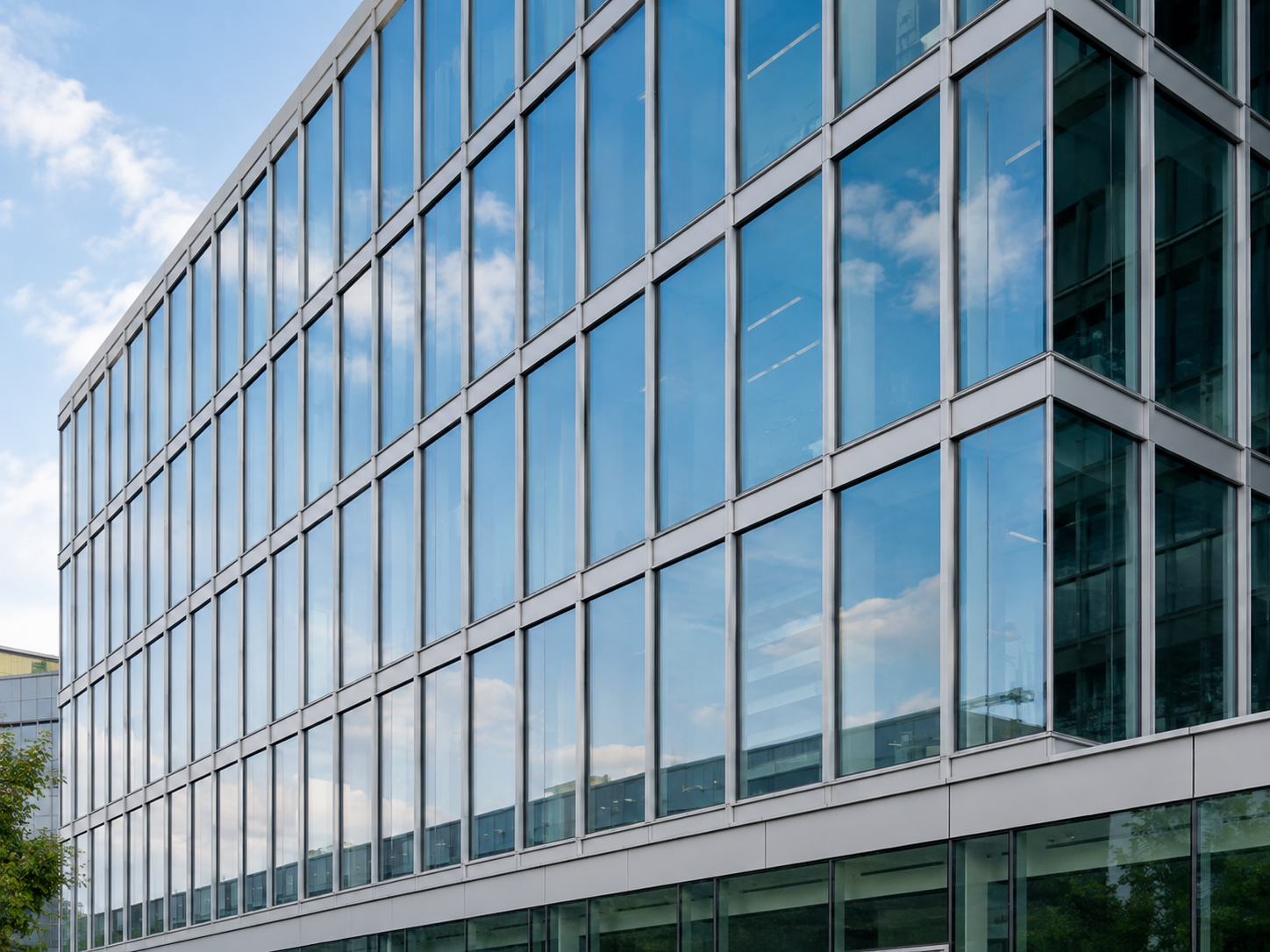
High-precision thermal break profiles integrated into complex commercial building envelopes.
3. Qualicoat Class 2 Powders & Marine-Grade Pre-Anodizing
Architectural longevity requires superior surface treatment performance. Primary aluminium extrusions undergo rigorous chemical pretreatment—including chromate-free alkaline etching and acidic deoxidization—followed by Qualicoat Class 2 super-durable architectural powder coating ($60\text{--}80\mu\text{m}$ film thickness) or Qualanod anodizing ($15\text{--}25\mu\text{m}$). For coastal, marine, or highly polluted industrial locations, seaside pre-anodizing treatment eliminates filiform corrosion risks, guaranteeing 25+ year color stability and UV resistance.
Headquartered in Kadıköy, Istanbul, Afes Aluminium operates at the epicenter of Europe's largest aluminium extrusion and architectural fabrication ecosystem.
01
Engineering-First Consultation
We start with structural drawings, opening schedules, and local energy codes. Our structural engineers verify wind loads ($q_p$), inertia moments ($I_x/I_y$), and glass weight deflection limits prior to commercial quoting.
Our thermal break windows are certified compliant with European Norms (EN 14351-1, EN 12207, EN 12208, EN 12210) and manufactured under ISO 9001 and ISO 14001 certified quality management frameworks.
04
Consolidated Envelope Supply
Eliminate procurement fragmentation. Source thermal break casement windows, architectural entrance doors, structural curtain wall systems, and minimal sliding doors under a single unified project supply contract.
05
Export Packaging & Freight Optimization
Windows are packed in steel-reinforced export A-frames or wooden crates with corner protection, vapor barrier wrapping, and floor-by-floor container packing lists to minimize site handling damage and unpacking overhead.
06
Incoterms & Customs Expertise
Complete commercial clarity with flexible shipping terms: EXW, FOB Istanbul, CIF target port, or DDP site delivery. We handle EUR.1 certificates of origin, ATR documents, commercial invoices, and packing lists.
Global Buyer & AI Query Intent Mining
Frequently Asked Questions: Thermal Break Aluminium Windows Procurement
Direct answers to common technical, commercial, and logistical questions asked by global contractors, structural engineers, and importers during product evaluation.
Non-thermal break aluminium windows consist of a continuous extruded solid aluminium profile frame. Because primary aluminium is highly conductive ($\lambda \approx 160\text{ to }200\text{ W/m}\cdot\text{K}$), heat travels rapidly between the interior and exterior sides, leading to extreme energy loss and surface condensation.
Thermal break aluminium windows separate the exterior and interior aluminium profile sections using a low-conductivity polyamide bar (PA66 GF25, $\lambda \approx 0.3\text{ W/m}\cdot\text{K}$). This mechanical thermal bridge interruption blocks thermal transfer, dramatically reducing the overall frame U-value ($U_f$) from over $5.0\text{ W/m}^2\text{K}$ down to $1.1\text{--}1.6\text{ W/m}^2\text{K}$.
PA66 GF25 is selected because its coefficient of thermal expansion ($\alpha \approx 2.8 \times 10^{-5}/\text{K}$) virtually matches that of extruded primary aluminium alloy (6063-T6, $\alpha \approx 2.3 \times 10^{-5}/\text{K}$). This dimensional equilibrium ensures that as window frames expand and contract during extreme temperature shifts (from $-30^\circ\text{C}$ winter conditions to $+70^\circ\text{C}$ solar exterior surface heating), the crimped joint between the aluminium profile and polyamide strip maintains full structural shear strength without delaminating or loosening over decades of use.
For heating-dominated cold climates (e.g., Northern Europe, North America, UK), the priority is minimizing whole window thermal loss ($U_w \le 0.8\text{ to }1.2\text{ W/m}^2\text{K}$) while allowing moderate solar gain ($\text{SHGC} \approx 0.40\text{--}0.55$) to passively warm interior spaces. Here, deep thermal break frames (75mm--90mm) with argon-filled triple Low-E glazing are recommended.
For cooling-dominated warm/tropical climates (e.g., Middle East, Caribbean, Southeast Asia), the key priority is restricting solar thermal radiation. High-performance solar control coated double glazing with a low SHGC ($\le 0.22\text{--}0.28$) is paired with a moderate thermal break frame profile (65mm with 24mm polyamide break). This blocks conductive thermal ingress from hot ambient outdoor air while preventing air conditioning thermal leaks from inside the building envelope.
When purchasing thermal break aluminium windows for international projects, buyers should verify test reports issued by accredited third-party laboratories according to harmonized European or American standards:
Air Permeability: EN 12207 (Class 4 target) or ASTM E283.
Water Tightness: EN 12208 (Class E900 or E1050 under static pressure) or ASTM E331.
Wind Load Resistance: EN 12210 (Class C4/C5 structural rating) or ASTM E330.
Thermal Performance: Calculated according to EN ISO 10077-2 or certified by NFRC / Passive House Institute.
Powder Coating Durability: Qualicoat Class 2 or AAMA 2604 / AAMA 2605 specifications.
On average, the raw material and fabrication cost of a thermal break aluminium frame is approximately 20% to 35% higher than an uninsulated aluminium frame of identical visual dimensions. This variance stems from the cost of precision PA66 GF25 extruded strips, dual-extrusion profile processing, specialized rolling/crimping assembly labor, and additional thermal chamber foam inserts.
However, when evaluated against whole-building life-cycle costs, thermal break windows offset this initial capital expenditure within 3 to 5 years through reduced HVAC tonnage capacity requirements and 30% to 45% lower annual heating and cooling energy consumption.
Yes. Every B2B order manufactured by Afes Aluminium in Istanbul is tailored to your exact architectural submittal drawings. We offer side-hung casement, tilt-and-turn, top-hung awning, parallel opening, fixed, and concealed sash configurations. Powder coatings are available in full RAL classic palettes, matte, textured, metallic finishes, and anodized tones (Natural Silver, Bronze, Champagne, Black). Multi-point locking hardware can be sourced from premier European hardware producers (Roto, Siegenia, G-U, Master) to ensure long operational durability.
Türkiye offers key geopolitical and logistical procurement benefits for global buyers. Compared to Asian suppliers, shipping from Istanbul provides drastically shorter sea transit times to Europe (5-7 days), the UK (8-10 days), North Africa (3-5 days), and the US East Coast (12-14 days), along with direct overland trucking across continental Europe. Furthermore, Türkiye benefits from the EU-Türkiye Customs Union agreement, facilitating streamlined customs clearance and preferential duty-free handling under EUR.1 documentation.
TR → GLOBAL
International Logistics & Freight Infrastructure
Seamless Global Supply directly from Istanbul Port Facilities
Afes Aluminium serves main contractors, real estate developers, commercial builders, and building material distributors across Europe, the United Kingdom, the Middle East, Africa, the Balkans, and the Americas.
Our dedicated export department handles complete documentation compliance—including Certificates of Origin (EUR.1 / ATR), Bills of Lading (B/L), CE Declaration of Performance (DoP) documents, test certificates, and custom commercial invoices—ensuring zero delays at destination customs clearance.
United Kingdom
European Union
Middle East & GCC
North America
Balkans & Eastern Europe
North & West Africa
Standardized B2B Procurement Workflow
From Architectural Drawings to On-Site Container Delivery
Our structured six-stage B2B project engineering protocol ensures precision execution at every milestone.
01
Architectural Review
Share your elevation drawings, CAD files, window schedules, performance targets ($U_w$), and destination port details.
02
Structural Engineering
Our technical team calculates profile wind deflection ($I_x$), structural thermal breaks, glass specs, and system depth options.
03
Commercial Proposal
Receive an itemized technical quotation outlining system specifications, surface finishes, glass build-up, and Incoterms (EXW, FOB, CIF).
04
Shop Drawings & Samples
We issue detailed fabrication shop drawings and produce structural profile corner cut-samples for architect approval.
05
Precision Fabrication
Extrusion, thermal break crimping, CNC machining, powder coating, assembly, and quality testing under ISO 9001 standards.
06
Export Freight & Delivery
Protective container packing, floor-by-floor labeling, shipping line booking, and full customs documentation dispatch.
Start Your Technical Inquiry
Require Engineering Specs or a Project Quote for Thermal Break Aluminium Windows?
Contact our Istanbul export engineering team today. Send your architectural drawings, window schedules, and performance requirements for a detailed technical evaluation and factory-direct proposal.