
Istanbul, Türkiye · Aluminium Industry Insights
Aluminium Systems Blog & Expert Guides
Technical insights, specification guidance and B2B export knowledge from the Afes Aluminium team.
CE Certified Soundproof & Thermal Window Systems
Engineered for high-decibel noise suppression ($R_w$ up to 48 dB), extreme air tightness, and sustainable thermal isolation across luxury residential and commercial developments.

Thermal Break Soundproof Openswing Window
- Profile: 6063-T5 Architectural Aluminum
- Glazing: 6mm+12A+6mm Laminated Acoustic
- Noise Reduction: STC 42 / $R_w$ 40 dB

Energy Efficient Noise Reduction Casement Window
- Profile: Polyamide Thermal Barrier (PA66GF25)
- Acoustic Cavity: Argon-filled Double Glazing
- U-Value: $1.4\text{ W/m}^2\text{K}$

French Inward Opening Double Glazed Casement
- Design: European Dual-Action Tilt & Turn
- Sealing: Triple-Track EPDM Gaskets
- Noise Attenuation: STC 44
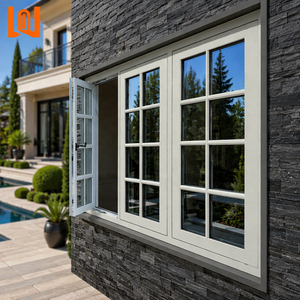
Commercial Double Glass Vinyl & Aluminum Window
- Core: High-Impact PVC / Extruded Aluminum
- Hardware: Multi-point Cam Locking System
- Air Tightness: Class 4 (EN 12207)
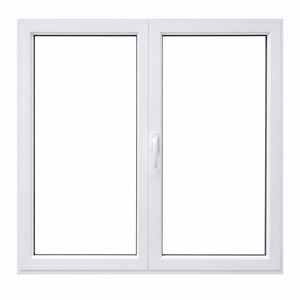
Inward Opening Sealed Acoustic Barrier Casement
- Glass Build-up: 8mm+1.52PVB+6mm / 16A / 6mm
- Sound Barrier: Tested $R_w$ up to 45 dB
- Application: Highway & Airport Adjacent Builds
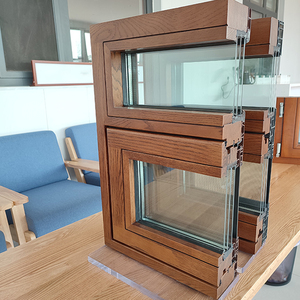
Aluminum Clad Wood Slimline Soundproof Window
- Interior: Solid Oak/Pine Timber Profile
- Exterior: Weatherproof Aluminum Cladding
- Thermal Performance: $U_w \le 1.1\text{ W/m}^2\text{K}$
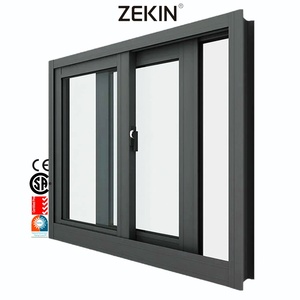
Acoustic Laminated Glass Sound Absorbing Sliding Window
- Interlock: Slimline 22mm Visible Sightline
- Acoustic Film: Solutia Vanceva PVB Interlayer
- Operation: Heavy-Duty Lift & Slide Rollers
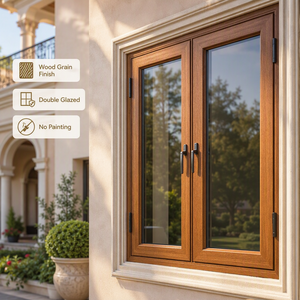
Wood Grain UPVC Double Glazed Soundproof Window
- Profile: 6-Chamber Lead-Free UPVC
- Reinforcement: Galvanized Steel Core
- Warranty: 5-Year Factory B2B Warranty
Engineering Sound Transmission Control: Mechanics of CE-Certified Acoustic Fenestration
An in-depth analysis of structural acoustic isolation, glass mass laws, damping interlayers, and factory quality control requirements under European Union standards.
Modern urban environments present severe acoustic challenges to real estate developers, facade engineers, and architectural specifies. Uncontrolled ambient noise—ranging from low-frequency heavy traffic rumblings (100 Hz–250 Hz) to mid-and-high-frequency aircraft and rail noise (500 Hz–4000 Hz)—directly impacts occupant health and property values. Sourcing certified CE Certified Soundproof Windows from reliable manufacturers requires an understanding of acoustic physics beyond simple glass thickness.
Sound attenuation in window assemblies is governed by the Mass Law, which dictates that sound transmission loss ($TL$) increases by approximately 6 dB for every doubling of the surface mass of the barrier. However, single homogeneous panes suffer from a severe degradation in performance known as the coincidence dip—where the bending wave velocity in the glass matches the acoustic wave velocity in the air. Professional acoustic window manufacturing overcomes this limitation through asymmetrical glass configurations and visco-elastic acoustic interlayers.
Acoustic Metrics: $R_w$ vs. STC
While the North American standard uses STC (Sound Transmission Class) evaluated between 125 Hz and 4000 Hz, European CE marking enforces $R_w$ (Weighted Sound Reduction Index) according to ISO 717-1, factoring in $C$ and $C_{tr}$ spectrum adaptation terms to account for urban road traffic noise.
Acoustic Engineering Insight: The Asymmetry Principle
Combining equal glass thicknesses (e.g., 6mm + 6mm) causes resonance frequencies to align, drastically reducing sound suppression at specific pitch ranges. A professional factory unit specifies asymmetrical double glazing (e.g., 8mm Float + 16mm Argon Gas + 6mm Laminated Acoustic Glass), shifting coincidental dips out of audible ranges and boosting sound isolation by up to +8 dB over standard units.
Four Pillar Construction of CE-Marked Acoustic Windows
How technical factories integrate structural aluminum, thermal breaks, acoustic glass, and perimeter seals into a unified fenestration package.
1. Multi-Chamber Profiles
Extruded 6063-T5/T6 structural aluminum or 6-chamber UPVC profiles designed with decoupled inner and outer walls. Internal multi-cavity geometries trap standing sound waves and break acoustic kinetic energy.
2. Polyamide Thermal Struts
High-precision PA66GF25 (25% glass fiber reinforced polyamide) thermal barriers physically separate exterior cold/heat from interior frames, preventing thermal bridging while dampening vibration transmission.
3. Acoustic PVB Laminates
Specialized visco-elastic Polyvinyl Butyral (PVB) acoustic interlayers sandwiched between glass sheets act as an internal shear damper, absorbing sound energy that usually passes straight through rigid glass.
4. EPDM Compression Seals
Continuous, non-aging Ethylene Propylene Diene Monomer (EPDM) gaskets engineered with triple-seal weatherstripping to eliminate air leakage paths—ensuring sound cannot bypass the glass via micro-gaps.
System Performance Matrix: Acoustic & Thermal Standards
A comparative structural overview of system performance categories tested in accredited factory laboratories per CE directives (EN 14351-1).
| Window System Type | Acoustic Isolation ($R_w$) | STC Rating | Thermal Coeff. ($U_w$) | Air Tightness Class | Primary Commercial Use Case |
|---|---|---|---|---|---|
| Double-Glazed Thermal Break Casement | $38 - 41\text{ dB}$ | STC 40 | $1.4\text{ W/m}^2\text{K}$ | Class 4 (EN 12207) | Urban Residential Apartments, Boutique Hotels |
| Acoustic Triple-Glazed Tilt & Turn | $42 - 45\text{ dB}$ | STC 44 | $1.0\text{ W/m}^2\text{K}$ | Class 4 (EN 12207) | Cold Climate High-Rises, Near-Highway Builds |
| Laminated Acoustic Lift & Slide System | $36 - 39\text{ dB}$ | STC 38 | $1.6\text{ W/m}^2\text{K}$ | Class 3 (EN 12207) | Luxury Villa Patios, Oceanfront Balconies |
| Alumi-Wood Hybrid Soundproof Casement | $44 - 48\text{ dB}$ | STC 47 | $0.9\text{ W/m}^2\text{K}$ | Class 4 (EN 12207) | Executive Offices, High-End Master Bedrooms |
| Heavy-Duty UPVC 6-Chamber System | $37 - 40\text{ dB}$ | STC 39 | $1.2\text{ W/m}^2\text{K}$ | Class 4 (EN 12207) | Mass Housing Projects, Educational Facilities |
Global B2B Sourcing & Future Sourcing Trends for Windows
Key developments shaping how real estate developers, facade contractors, and procurement offices source soundproof fenestration globally.
Transition to Micro-Acoustic Metamaterials
Traditional acoustic isolation relies heavily on glass mass. Next-generation factory manufacturing integrates micro-perforated acoustic metamaterials inside frame cavities, canceling targeted noise wavelengths without increasing overall frame weight or depth.
Demand for Carbon-Neutral Recycled Aluminum
European construction standards now heavily weight Environmental Product Declarations (EPDs). Leading manufacturers are adopting low-carbon aluminum billets produced via hydroelectric power (under 4.0 kg $\text{CO}_2$/kg Al), combining acoustic efficiency with ESG compliance.
Unitized Facades with Built-in Micro-Ventilation
Developers no longer accept airtight soundproof windows that force rooms to remain completely sealed. Future procurement prioritizes acoustic trickle vents and labyrinth-path ventilation channels that supply fresh air while muffling ambient noise.
BIM Integration & Modular Off-Site Prefabrication
B2B procurement is moving toward direct factory integration with Building Information Modeling (BIM) files (LOD 350+). Pre-glazed, pre-tested window units arrive on site ready for fast crane installation, cutting site labor costs by up to 40%.
Factory Advantage: Rigorous Engineering & Global Export Compliance
How our direct manufacturing facilities provide seamless technical execution from shop drawings to job-site container offloading.
CE & ISO Certified Quality Control
Every production batch undergoes strict Factory Production Control (FPC) testing under CE EN 14351-1 standards, covering wind pressure resistance, air permeability, watertightness, and acoustic transmission verification.
Bespoke Architectural Engineering
Our export engineering team converts client Architectural Elevation Drawings and Window Schedules into precise CNC fabrication files, offering custom RAL powder coating, anodizing, and wood-grain surface treatments.
Export Container Logistics Protection
Windows are individually wrapped in protective anti-scratch films, corner-protected, and packed into steel-reinforced wooden crates optimized for full container load (FCL) sea freight with zero breakages.
Frequently Asked Questions by International Buyers
Clear, direct answers regarding CE compliance, OEM customization, shipping Incoterms, and acoustic specifications.
What specific test reports validate your CE Certification for soundproof windows?
Our window assemblies are tested under EN 14351-1 (the harmonized standard for windows and external pedestrian doorsets). Acoustic performance is certified via laboratory sound insulation testing in accordance with ISO 10140-2 and rated according to ISO 717-1 ($R_w$, $C$, and $C_{tr}$). CE documentation and Factory Production Control (FPC) certificates are included with every project shipment.
How do thermal break aluminum profile depths affect acoustic isolation?
Deeper profile frame depths (such as 70mm, 75mm, or 85mm series) accommodate wider insulated glass units (IGUs) with expanded air/gas cavities (up to 20mm) and thicker acoustic laminated glass panes (up to 12.52mm). Additionally, deeper profiles allow multi-chamber polyamide struts (PA66GF25) that prevent frame wall vibration resonance.
Can we specify custom glass configurations such as Low-E or Solar Control alongside acoustic PVB?
Yes. We specialize in custom multi-function glazing build-ups. A common configuration includes an outer pane of Low-E toughened glass, an Argon-filled gas cavity with warm-edge spacers, and an inner pane of acoustic laminated glass with a specialized sound-dampening PVB interlayer—achieving high thermal efficiency ($U_w < 1.2\text{ W/m}^2\text{K}$) and noise attenuation ($R_w > 42\text{ dB}$) simultaneously.
What is the typical manufacturing lead time for container orders?
Standard production lead time is 25 to 35 calendar days after final approval of CAD shop drawings and deposit confirmation. For custom extruded profile dies or specialized non-standard RAL powder coat finishes, add 7 to 10 days. We provide continuous production updates and photo verification prior to container packing.
Which trade Incoterms and international payment terms do you accept?
We regularly execute contracts under EXW, FOB (Shanghai/Ningbo/Guangzhou), CIF, and DDP Incoterms. Standard commercial payment terms are a 30% T/T deposit upon order confirmation and shop drawing lock, with the remaining 70% balance payable against the presentation of the Bill of Lading (B/L) or an irrevocable Irrevocable Letter of Credit (L/C at sight).
How do casement windows compare to sliding windows for sound isolation?
Casement windows generally deliver superior acoustic performance ($R_w$ is typically 3–6 dB higher than sliding windows of equal glass spec). This is because casement sash edges compress tight against continuous EPDM rubber perimeter gaskets when locked. Sliding windows rely on brush seals which can allow acoustic micro-leakage, though specialized Lift & Slide mechanisms significantly bridge this performance gap.
Do you provide hardware options suitable for commercial traffic levels?
Yes. We partner directly with premium hardware manufacturers including German SIEGENIA, ROTO Frank, HOPPE, as well as top-tier domestic multi-point lock systems rated for over 50,000 opening cycles—ensuring heavy acoustic glass sashes operate smoothly without sash sag over time.
What information is required to receive an exact technical quote?
Please provide your project Window Schedule or elevation drawings specifying dimensions ($W \times H$), opening types (tilt & turn, casement, fixed), target acoustic ($R_w$/STC) or thermal requirements ($U_w$), aluminum frame finish (RAL color), and destination port. Our technical sales team will issue a comprehensive itemized proposal within 24 hours.
Ready to Source CE-Certified Soundproof Windows for Your Project?
Connect directly with our factory engineering team for shop drawing reviews, acoustic performance validation, and competitive direct-from-manufacturer pricing.
Inquire Now