
Luxury villa with floor-to-ceiling aluminium window systems supplied from Turkey

Istanbul, Türkiye · Aluminium Industry Insights

Aluminium Systems Blog & Expert Guides

Technical insights, specification guidance and B2B export knowledge from the Afes Aluminium team.

0%

Choosing a reliable China Best Hotel Architectural Aluminium Solutions Supplier requires more than comparing prices. Hotel architectural aluminium solutions must balance appearance, safety, durability, and installation performance. A successful project begins with clear drawings, verified material grades, and realistic performance targets.

Experienced suppliers understand how aluminium behaves across hotel façades, entrance systems, curtain walls, balconies, skylights, and interior partitions. They review wind loads, thermal movement, drainage paths, glass compatibility, and coastal corrosion risks. They also coordinate shop drawings with architects, contractors, and site teams. Small details matter. Poor sealing can damage an expensive façade.

Dr. Helmut Knaack, a respected façade engineering researcher, has stated, “The façade is the interface between inside and outside.” This principle remains highly practical for hospitality projects. Guests may notice the clean lines first. They may also feel unwanted heat near a glazed lobby. The supplier must connect visual design with measurable comfort.

A dependable China supplier should provide alloy certificates, coating specifications, sample approvals, test reports, and traceable production records. Factory experience is valuable, but documented quality control matters more. Ask about thermal breaks, powder coating, PVDF finishes, hardware brands, tolerances, packaging, and replacement procedures.

No aluminium system is perfect. Coastal hotels may need stronger corrosion protection. Large openings can create thermal and structural challenges. Even an attractive design may fail without careful installation. That is why professional consultation, factory inspection, and site feedback should guide the final decision. The right Hotel architectural aluminium solutions supplier delivers more than components. It delivers a coordinated building envelope for long-term hotel performance.
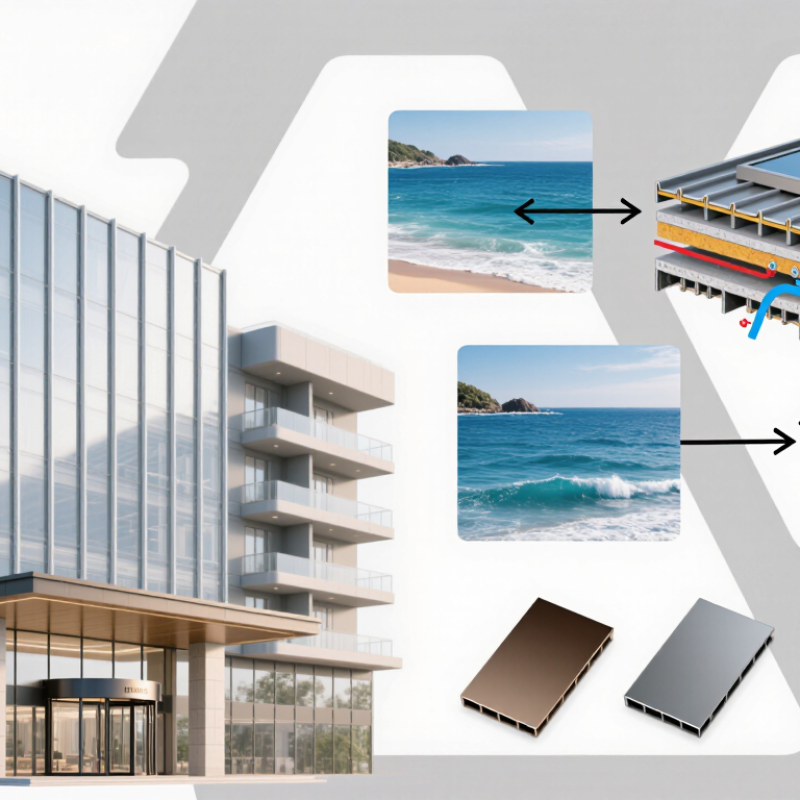
China Best Hotel Architectural Aluminium Solutions Supplier

Hotel Aluminium Demand: Market Scope and 2024 Construction Trends

China Best Hotel Architectural Aluminium Solutions Supplier

Hotel aluminium demand is expanding through new construction, renovation, and energy-saving upgrades. The International Aluminium Institute estimates that building and construction consume about 25% of global aluminium output. This share supports demand for curtain walls, windows, doors, railings, and lightweight interior systems.

China’s 2024 market was uneven. The National Bureau of Statistics reported a 10.6% decline in real estate development investment and a 23.0% fall in new housing starts. Hotel projects still moved forward, but developers became more selective. Renovated lobbies, coastal resorts, and business hotels often required durable aluminium with slimmer profiles. Practical details mattered: concealed drainage, thermal breaks, corrosion-resistant finishes, and accurate corner joints.

Energy performance shaped specifications more strongly in 2024. The United Nations Environment Programme reported that buildings and construction represented 32% of global energy use and 34% of energy-related carbon emissions in 2022. Hotel owners therefore examined window performance, solar control, and maintenance cycles, not only purchase price. This is where architectural aluminium can reduce operational burdens. However, material selection alone cannot solve inefficient building design. That assumption needs caution. Suppliers should provide tested thermal data, coating records, fabrication samples, and installation guidance. Project teams also need realistic lead times, because custom extrusions and imported hardware can disrupt hotel opening schedules. Lodging demand remains sensitive to tourism, financing, and local policy. Forecasts are useful, but site-level evidence still matters.

6063-T5 Aluminium Profiles: Grades, Strength, and Finish Standards

China Best Hotel Architectural Aluminium Solutions Supplier

6063-T5 is widely used for hotel doors, window frames, curtain-wall trims, and balcony screens. Its magnesium-silicon chemistry supports clean extrusion and reliable corrosion resistance. Typical minimum tensile strength is about 152 MPa, with yield strength near 110 MPa, according to common ASTM B221 product requirements. Actual values depend on section thickness and heat treatment. Check the mill certificate, not only the catalogue.

Finish selection changes both appearance and service life. Anodizing should follow ISO 7599, while architectural coating specifications often reference AAMA 611, AAMA 2603, 2604, or 2605. Higher-performance coatings suit humid coastal hotels and heavily cleaned public areas. The International Aluminium Institute reports that aluminium demand remains closely linked to construction and transport growth. USGS estimated global aluminium smelter output at roughly 70 million metric tons in 2023. Scale matters, but quality still depends on extrusion control, surface preparation, and inspection. One weakness remains: colour matching can shift between production batches.

Tips: Specify alloy, temper, wall thickness, finish, and tolerance together. Request salt-spray, coating-thickness, and adhesion records. For guest-facing areas, inspect corners closely. Small defects become obvious under lobby lighting.

China Best Hotel Architectural Aluminium Solutions Supplier - 6063-T5 Aluminium Profiles: Grades, Strength, and Finish Standards

Representative minimum mechanical properties for commonly specified extruded aluminium profiles.

6063-T5

A widely used architectural extrusion temper, offering good surface quality, corrosion resistance, and practical strength for frames, doors, windows, and hotel interiors.

Finish Standards

Architectural anodizing is commonly specified to AAMA 611. Organic powder coatings may be specified to AAMA 2603, AAMA 2604, or AAMA 2605 according to performance requirements.

Specification Note

Strength values can vary with section thickness, product form, and the governing standard. Confirm the final requirements against the applicable EN, ASTM, or local specification.

Thermal Performance: Curtain-Wall U-Values Below 1.8 W/m²K

China Best Hotel Architectural Aluminium Solutions Supplier

Hotel façades must control heat loss without weakening daylight, views, or design freedom. A curtain-wall U-value below 1.8 W/m²K can support this balance. It is a practical thermal target. The result depends on the complete assembly, not the aluminium frame alone. Glazing, thermal breaks, gaskets, spacers, and edge details all affect performance.

Experienced project teams begin with climate data and façade orientation. A west-facing guestroom may need stronger solar control than a shaded lobby. We review frame geometry, glass specification, and junction details before production. Computer calculations can identify cold bridges around floor slabs and window corners. Physical testing then checks air leakage, water resistance, and thermal behavior. Small gaps matter.

Installation quality remains decisive. Poorly compressed seals or misplaced insulation can reduce expected performance. We have seen attractive drawings fail at these details. That experience encourages better site inspections and clearer installation guidance. Test reports, calculation records, and material traceability also help owners verify the stated U-value. The target is achievable, but it should never be treated as automatic.

Hotel Façade Compliance: AAMA 501.2, EN 13830, and ISO 9001

China Best Hotel Architectural Aluminium Solutions Supplier

Hotel façades must resist wind, rain, movement, and repeated maintenance. Aluminium systems help achieve this when design and installation work together. Compliance is not just a certificate on paper.

AAMA 501.2 provides a practical field water-check method for installed curtain walls. Technicians use a calibrated nozzle around joints, gaskets, corners, and transitions. The test can reveal visible leakage, but it does not replace every required performance test. Site records should include test areas, weather conditions, equipment, and corrective actions.

EN 13830 defines performance requirements for curtain walling products in European projects. It addresses areas such as air permeability, watertightness, wind resistance, and thermal performance. Project designers must still confirm the declared values and local regulatory requirements.

ISO 9001 supports a controlled quality management process. It can improve drawing reviews, material traceability, inspection records, and nonconformance handling. It does not certify a façade’s structural performance.

In practice, reliable suppliers review aluminium grades, coating specifications, glass interfaces, drainage paths, and fixing details before production. Small errors matter. A misplaced gasket can create a hidden leak after handover. Factory inspections and mock-up testing reduce this risk, but they do not eliminate it. Some projects still expose weak communication between architects, fabricators, and installers. That gap deserves honest review. Clear documentation, trained site teams, and independent verification create stronger evidence for hotel façade compliance.

Supplier Evaluation: Lead Times, Testing Capacity, and Project Support

China Best Hotel Architectural Aluminium Solutions Supplier

For hotel aluminium packages, supplier evaluation starts with a date, not a promise. Ask for a procurement schedule with approval, tooling, extrusion, finishing, packing, and delivery milestones. Standard profiles may ship in three to five weeks. Custom dies, thermal breaks, and anodizing can extend production to eight to twelve weeks. The McKinsey Global Institute reported that construction productivity grew about 1% annually over two decades, compared with 2.8% across the economy. Delayed decisions can therefore create serious site disruption. A reliable supplier should show extrusion capacity, finishing lines, backup processors, and weekly reporting. Request lot-level traceability.

Testing capacity deserves equal weight. Request test plans for alloy chemistry, coating thickness, color variation, and dimensional tolerance. For facade assemblies, verify air, water, and structural performance through applicable ASTM E283, E331, and E330 procedures. Check calibration dates and independent laboratory reports. Test early.

Tips: Put one sample corner into the contract. Define finish codes, gloss ranges, packing methods, replacement timing, and acceptance limits. Request a physical mock-up before mass production. A photo is not evidence. Yet testing budgets are often reduced first. That habit needs review. Project audits sometimes reveal an uncomfortable gap: materials pass testing, but coordination drawings remain incomplete. Require signed shop drawings, interface details, and a named project engineer. Support means resolving details before hotel rooms are waiting.

China Best Hotel Architectural Aluminium Solutions Supplier - Supplier Evaluation: Lead Times, Testing Capacity, and Project Support

Evaluation Dimension What to Evaluate Practical Benchmark Required Evidence Project Risk if Not Verified
Initial Technical Response Ability to review drawings, specifications, finishes, quantities, and performance requirements. A complete technical response within 2–5 working days for a clearly defined inquiry. Written clarification list, drawing review comments, material proposal, and exclusions. Unclear scope, repeated revisions, and late cost changes.
Sample and Mock-Up Lead Time Time needed for colour samples, profile samples, corner details, and hotel façade or interior mock-ups. Commonly 7–21 calendar days, depending on tooling, finish, and mock-up complexity. Sample schedule, approval milestones, finish control samples, and revision procedure. Late design approval and inconsistent appearance across elevations or floors.
Tooling and Profile Development Capability to develop custom aluminium extrusions, dies, trims, brackets, and connection details. Die design and trial extrusion should be scheduled separately from mass production; a documented approval gate is essential. Section drawings, die-flow review, trial inspection report, and dimensional approval record. Profile distortion, poor fit-up, installation delays, and unplanned tooling costs.
Production Lead Time Time from approved drawings and finish samples to production readiness and shipment. For repeat profiles, a planning range of 20–45 calendar days is commonly used; custom systems may require longer. Baseline schedule, capacity allocation, raw-material plan, and weekly progress updates. Missed installation windows, storage costs, and hotel opening delays.
Quality Inspection Capacity Incoming-material inspection, in-process checks, final inspection, traceability, and non-conformance control. Inspection plans should define sampling frequency, acceptance criteria, responsible personnel, and corrective-action timing. Inspection and Test Plan, batch records, dimensional reports, coating reports, and corrective-action reports. Hidden defects, inconsistent batches, and difficult claims after delivery.
Dimensional and Mechanical Testing Verification of profile dimensions, alloy condition, tensile properties, hardness, and fit with adjacent components. Testing should reference the project specification and applicable standards such as EN 755, EN 12020, ASTM B221, or an agreed equivalent. Laboratory reports showing sample identification, test method, results, date, and approval status. Structural non-compliance, assembly problems, and rejected lots.
Surface Finish and Colour Control Powder coating or anodizing consistency, gloss, colour, coating thickness, adhesion, and appearance. Acceptance criteria should be approved against physical control samples and the specified coating system, such as AAMA 2603, AAMA 2604, AAMA 2605, or an agreed equivalent. Colour-control records, coating-thickness readings, adhesion results, gloss readings, and batch traceability. Visible colour variation, premature finish failure, and costly replacement work.
Corrosion and Environmental Suitability Suitability for coastal, humid, urban, or high-traffic hotel environments, including drainage and galvanic-isolation details. The coating system, alloy, pretreatment, sealants, fasteners, and exposure category should be selected together rather than evaluated separately. Exposure assessment, pretreatment specification, corrosion-test records where required, and installation guidance. Blistering, staining, white corrosion, and shortened service life.
Packaging and Logistics Control Protection against scratches, deformation, moisture, and mixing of batches during transport and site handling. Packaging should be defined by profile length, finish sensitivity, bundle weight, container limitations, and unloading method. Packing drawings, photographs, loading plan, shipping marks, and quantity reconciliation. Transit damage, installation confusion, and material shortages on site.
Project Documentation Completeness and control of shop drawings, material schedules, installation details, operation guidance, and inspection records. Documents should use revision control and be issued according to an agreed submittal register. Submittal register, drawing list, revision history, approval log, and final handover dossier. Installation errors, approval disputes, and incomplete handover records.
Site and Installation Support Ability to support sequencing, interface coordination, installation questions, and corrective actions during construction. A named technical contact, defined response time, installation guide, and remote or on-site support process should be agreed before production. Contact matrix, escalation procedure, installation method statement, and site-issue log. Slow decisions, rework, interface conflicts, and programme disruption.
Commercial and Change Control Transparency of assumptions, tooling, minimum quantities, price validity, variations, and replacement responsibility. The quotation should clearly separate material, finishing, tooling, packaging, testing, delivery, and optional services. Detailed quotation, responsibility matrix, change-order form, warranty terms, and claim procedure. Budget overruns, ambiguous responsibilities, and delayed variation approval.

Note: Lead-time figures are planning benchmarks rather than guarantees. Final delivery timing depends on design approval, tooling, alloy availability, finish selection, order quantity, inspection requirements, and shipping arrangements.

FAQS

Why is aluminium demand growing in hotel construction?

Demand comes from new hotels, renovations, and energy-saving upgrades. Aluminium is used for windows, doors, curtain walls, railings, and interior systems.

What happened to China’s hotel construction market in 2024?

The market was uneven. Real estate investment fell 10.6%, while new housing starts dropped 23.0%. Hotel projects continued, but developers selected materials more carefully.

Which aluminium features matter most in hotel projects?

Important features include concealed drainage, thermal breaks, corrosion resistance, and accurate corner joints. Slimmer profiles can also improve the appearance of lobbies and guest areas.

How can aluminium support hotel energy performance?

Well-designed window systems can improve thermal control and reduce maintenance pressure. Solar control also matters in bright rooms. Aluminium alone cannot fix poor building design.

What is 6063-T5 aluminium commonly used for?

It is commonly used for hotel doors, window frames, curtain-wall trims, and balcony screens. It supports clean extrusion and reliable corrosion resistance.

What strength can buyers expect from 6063-T5 profiles?

Common minimum tensile strength is about 152 MPa. Yield strength is near 110 MPa. Actual results depend on wall thickness and heat treatment.

Which finish should hotels choose for aluminium profiles?

Anodizing suits many architectural applications. Higher-performance coatings are better for humid coastal hotels and heavily cleaned public areas. Finish records should be checked.

What quality documents should a hotel project request?

Request mill certificates, coating-thickness records, adhesion results, and salt-spray data. Ask for fabrication samples too. A catalogue is not enough.

What problems can occur during hotel aluminium production?

Colour may shift between production batches. Small corner defects can become obvious under strong lobby lighting. Custom profiles and hardware may also delay opening schedules.

Can aluminium selection guarantee lower hotel operating costs?

No. It can reduce some thermal and maintenance burdens, but the building design still controls much of the result. Forecasts help, but site evidence matters more.

Conclusion

The hotel architectural aluminium solutions market is expanding as new hotels, renovations, and mixed-use developments demand durable, lightweight, and energy-efficient façade systems. This overview examines 2024 construction trends, including the growing use of 6063-T5 aluminium profiles for their balanced strength, workability, corrosion resistance, and suitability for anodized or powder-coated finishes. It also highlights the importance of consistent surface quality and finish standards in achieving a refined hotel appearance.

Thermal performance is a key consideration, with curtain-wall systems designed to target U-values below 1.8 W/m²K through thermal breaks, insulated glazing, and careful interface design. Hotel façades must also be evaluated against relevant performance requirements, including AAMA 501.2 and EN 13830, supported by reliable quality-management practices such as ISO 9001. When selecting a supplier, developers should assess lead times, testing capacity, engineering support, customization ability, documentation, and project coordination to ensure dependable delivery from design development through installation.

Lillian

Lillian

Lillian is a dedicated marketing professional with a strong understanding of the company’s products, customers, and industry landscape. Through a combination of strategic insight, clear communication, and practical market knowledge, she helps introduce the company’s solutions to audiences in a......