Commercial aluminium façade systems shape a building’s first impression, but their value goes well beyond appearance. They can support weather protection, daylight control, and thermal performance when the frame, glazing, insulation, and installation are designed as one assembly. Details matter. A narrow mullion may look elegant on a drawing, yet poorly resolved drainage or thermal breaks can create problems after the first hard rain.
Architect Ludwig Mies van der Rohe’s familiar principle, “Less is more,” offers a useful lens for façade design. It is not a promise that minimal detailing always performs well. Rather, it invites designers to make each visible line and junction earn its place. For commercial projects, that means considering wind loads, local climate, maintenance access, and the building’s intended use before choosing finishes or module sizes. A silver anodized frame can suit one setting; a darker finish may show dust and scratches more readily.
There is no universal system. A coastal office, a busy retail frontage, and a mid-rise workplace face different demands. Even a good specification can disappoint if site tolerances, sealant work, or installer coordination are weak. That part is easy to underestimate. This introduction explores why commercial aluminium façades are widely selected, what their practical strengths and limits are, and which design and construction decisions deserve closer attention.
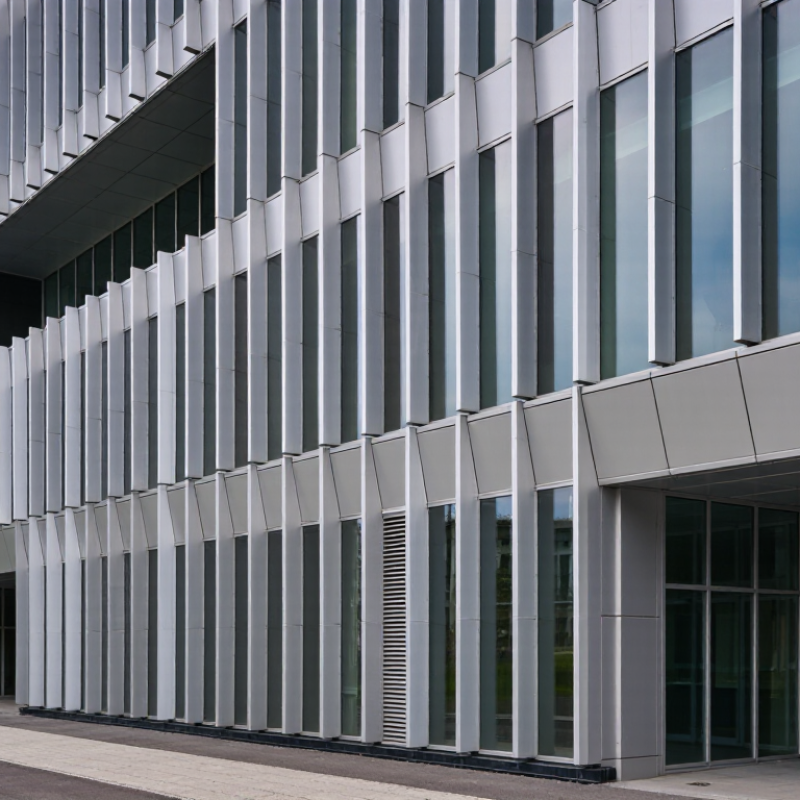
How Commercial Aluminium Facades Balance Strength, Weight, and Design Flexibility
Why Choose Commercial Aluminium Facade Systems?
How Commercial Aluminium Facades Balance Strength, Weight, and Design Flexibility
Commercial aluminium facades combine structural performance with relatively low material weight. The Aluminum Association’s design references give aluminium a density of about 2.7 g/cm³, compared with roughly 7.85 g/cm³ for steel. This helps reduce the dead load carried by supporting structures. That matters. But a lightweight frame alone does not guarantee a lightweight facade; glass, brackets, and deep profiles also add weight.
Aluminium profiles can be extruded into shapes that accommodate glazing, shading, and drainage details. The International Aluminium Institute reports that recycling aluminium typically requires about 5% of the energy used to produce primary aluminium. That figure supports careful material recovery, not a claim that every facade has low environmental impact. Design flexibility comes with trade-offs. More complex profiles can complicate fabrication, installation, and maintenance.
Strength depends on the alloy, profile geometry, connections, and site-specific wind loads. Thermal breaks and well-detailed joints also matter, especially where indoor comfort and condensation are concerns. In practice, I would check structural calculations and mock-up details rather than judge a system by appearance or material alone. One caution remains. Aluminium frames can conduct heat readily, and poorly coordinated interfaces may undermine an otherwise sound design.
Why Choose Commercial Aluminium Facade Systems?
How commercial aluminium facades balance strength, weight, and design flexibility
At approximately 2,700 kg/m³, aluminium has about one-third the density of carbon steel, supporting lighter facade components and flexible profile design. Actual strength and system weight depend on the alloy, geometry, connections, glazing, and project design.
Typical reference densities; values are approximate and compare equal volumes of material, not complete facade systems. Sources: The Engineering Toolbox material-property references and standard material-property data.
How NFRC U-Factor and SHGC Ratings Guide Facade Energy Performance
Why Choose Commercial Aluminium Facade Systems?
How NFRC U-Factor and SHGC Ratings Guide Facade Energy Performance
A slim aluminium frame can create broad, bright openings, but its appearance does not reveal its thermal performance. NFRC ratings help compare complete fenestration products under standardized conditions. U-factor measures heat transfer; lower values generally mean better insulation. SHGC measures how much solar heat passes through glazing, on a scale from zero to one. The right balance depends on climate, orientation, shading, and building use. A west-facing conference room with afternoon sun may need a lower SHGC than a shaded north-facing lobby. Small details matter.
The U.S. Department of Energy’s Energy Saver guidance reports that windows account for 25–30% of residential heating and cooling energy use. That is not a commercial-facade prediction, but it underlines why glazing deserves careful review. NFRC-certified ratings provide useful product comparisons; they do not describe the entire facade. Aluminium frames, thermal breaks, edge spacers, installation gaps, and surrounding wall construction also affect real-world performance. One honest limitation: a strong product rating cannot rescue a poorly detailed junction. Ask for certified ratings for the exact frame-and-glass configuration, then review them alongside project-specific energy modeling. The spreadsheet may look tidy. The building envelope rarely is.
Why Choose Commercial Aluminium Facade Systems? - How NFRC U-Factor and SHGC Ratings Guide Facade Energy Performance
Compare representative performance ranges for common commercial aluminum facade glazing configurations. Lower U-factor indicates less heat transfer; SHGC ranges from 0 to 1, with lower values indicating less solar heat gain.
| Facade glazing configuration |
Typical construction |
Representative U-factor
(Btu/h·ft²·°F) |
Approx. U-factor
(W/m²·K) |
Representative SHGC |
Energy-performance consideration |
| Aluminum frame, single glazing |
Single clear glass; non-thermally broken frame |
1.00–1.20 |
5.68–6.81 |
0.65–0.80 |
High heat transfer and solar gain; generally less effective for reducing heating and cooling loads. |
| Thermally broken aluminum, double glazing |
Insulated glass unit with clear glass and a thermal break in the frame |
0.45–0.65 |
2.56–3.69 |
0.50–0.70 |
The thermal break reduces heat flow through the frame; clear glass can still admit substantial solar heat. |
| Thermally broken aluminum, double low-e glazing |
Double glazing with a low-emissivity coating; gas fill may be used |
0.30–0.50 |
1.70–2.84 |
0.25–0.50 |
Low-e coating can reduce heat transfer and, depending on its properties, limit solar heat gain while retaining daylight. |
| Thermally broken aluminum, triple glazing |
Three glass panes with two insulating cavities; low-e coatings are common |
0.20–0.35 |
1.14–1.99 |
0.20–0.45 |
Can offer lower heat transfer, but adds weight and cost; frame, edge, and installation performance still matter. |
How to use these figures: The ranges are illustrative reference values, not certified ratings for a specific product. NFRC U-factor and SHGC ratings are product-specific and should be checked on the applicable NFRC label or certified product data. Ratings depend on glass make-up, coatings, gas fill, spacer, frame design, and product size. NFRC fenestration ratings do not by themselves describe the energy performance of an entire facade, including opaque areas, thermal bridges, air leakage, and installation details.
How AAMA 2605 Tests Coating Durability Through 10-Year Florida Exposure
Commercial aluminium facade systems must withstand years of sun, rain, humidity, and temperature changes. AAMA 2605 sets demanding performance criteria for high-performance coatings, including a 10-year outdoor exposure test in South Florida. Test panels are typically mounted facing south at an angle, where intense sunlight and moisture challenge the finish.
After exposure, evaluators check properties such as color change, gloss retention, chalking, and coating integrity. This gives architects and building owners a useful basis for comparing finishes. It does not predict the exact life of every facade. Panel orientation, cleaning, installation details, and local conditions still matter. A test is not a promise. Real buildings are messier than test racks.
Tips: Request current test documentation, and confirm that it covers the coating and substrate specified for your project. Compare samples in natural light; a small color shift can be easier to notice across a large facade. Also ask how the finish should be cleaned. That detail is easy to overlook.
Why Aluminium Recycling Matters: IAI Reports 95% Less Energy Than Primary Production
Why Choose Commercial Aluminium Facade Systems?
Aluminium recycling offers a substantial energy advantage. The International Aluminium Institute (IAI) reports that recycling uses about 5% of the energy required to produce primary aluminium—a saving of roughly 95%. The Aluminum Association’s sustainability report gives a similar figure. For commercial facades, this matters: long runs of panels, fins, and frames can contain considerable metal. But the 95% figure applies to producing recycled metal, not the full energy footprint of a finished facade. Still, context matters.
On renovation sites, clean, separated aluminium scrap is easier to recover than mixed waste. Coatings, sealants, screws, and thermal breaks complicate sorting. They do not disappear because a frame is recyclable. Specify accessible connections and record alloy types to help crews separate components later. Not the whole story. Recycled feedstock can vary in availability and composition, so ask fabricators for verified recycled-content data rather than assuming every system contains a high proportion. Even a carefully detailed frame can be downcycled when demolition crews lack time or clear material records.
How to Compare Facade Systems by Performance, Certification, and Lifecycle Value
Choosing a commercial aluminium façade means comparing evidence, not just price.
Ask for tested values for thermal transmittance, air leakage, water penetration, and wind resistance.
Check that reports match the proposed glass, seals, anchors, and opening sizes. A certificate for one configuration may not cover another.
Details matter.
UNEP’s 2023 Global Status Report for Buildings and Construction estimated that buildings accounted for 34% of global energy demand and 37% of energy- and process-related carbon emissions in 2022.
That context makes operational performance worth checking carefully. I still find it easy to oversimplify: one U-value cannot describe a whole elevation.
Review shading, orientation, and junction details alongside the stated thermal performance. Then compare maintenance needs, replacement cycles, and end-of-life assumptions.
The RICS Whole Life Carbon Assessment for the Built Environment framework provides a method for assessing impacts across a building’s life cycle. Use it to compare options beyond their initial cost.
A spreadsheet can miss site realities. Ask how damaged panels can be accessed and replaced without disturbing adjacent units.
A slightly higher purchase price may make sense, but only when the documented performance and service plan support it.
Conclusion
Commercial aluminium façade systems offer a practical balance of structural strength, relatively low weight, and design flexibility, making them suitable for a wide range of commercial buildings. Their performance depends not only on appearance, but also on how effectively the façade manages heat transfer and solar gain. NFRC U-factor and SHGC ratings help compare these energy-related properties, while AAMA 2605 testing, including long-term exposure in Florida, provides a basis for assessing coating durability and resistance to weathering.
A well-informed comparison should consider verified performance, relevant certifications, maintenance needs, and expected service life together. Aluminium’s recyclability also contributes to lifecycle value: industry reporting indicates that recycling aluminium uses about 95% less energy than producing primary aluminium. By weighing these factors as a complete system, project teams can select a façade that supports design goals, energy performance, durability, and responsible material use.